
The real world is complex. It is changing very fast. So the optimal solution probably doesn’t exist. If it does exist, it doesn’t stay the optimal solution for long. To the extent that Artificial Intelligence focuses our choices and behaviors on the optimal solution, we’re in trouble.
If we put too much pressure on the algorithms to only make optimal selections, then we’re going to end up with very fragile systems that lack diversity. There are already some big examples of this. Look at the US political system. You have Republicans who are being shown the best social media messages, the optimal messages, that will make them click or tap. You have Democrats who are being shown the best social media messages, the optimal messages, that will make them click.
Result? A more fragile public sphere.
These two forces live in tension with each other. Mixing is inefficient if you are trying to optimize the number of clicks. But put too much pressure on Mixing up our usual patterns, and that’s not helpful, either. (If every day my news feed shows me a random collection of stories, it’s very hard to learn. My world becomes chaotic.)
But there’s a zone in between these two extremes, where the power to select what fits our pattern and the power to see our pattern and break it up, balance each other out. And we know that zone exists. Because_ Mixing and _Selecting, these two forces, are the same forces responsible for natural evolution. They are the forces that made us, in nature.
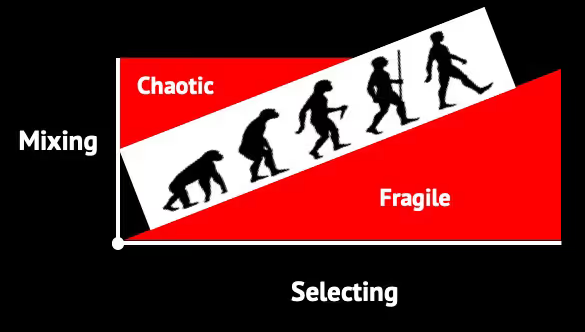
If we can build algorithms that can help us find that zone, faster, more often, in business and society…wow. We would accelerate the evolution of human technology and culture and society. This is the zone in which evolution happens. In which learning happens. In which innovation happens. In which we develop resilience to systemic shocks, like climate change, or fake news, or a sudden swing in consumer demand for our product.
If you can see this picture of AI, then you start to see all the mistakes people and businesses are making with AI today. All the opportunities being missed. And you can communicate a powerful vision for the positive role that AI can play in getting us all to a different, more beautiful, more advanced world. Faster.
We talk about all this and more in this episode of The Atlas Project.
- Our conversation was inspired by Chris's most recent newsletter. You can find it here: http://kutarna.net/map-44-how-can-a-i-best-serve-humanity/.
- To see if a robot is going to take your job: https://willrobotstakemyjob.com.
Transcript
Transcribed by machine from the recording.
Scott Chris, my friend, welcome back to England. I say that like I'm in England, but you, I mean, I'm welcoming you home even though I'm not in your home.
Chris You know, the Prince of Wales, there's just around the corner.
Scott The Prince of Wales does?
Chris You saw the story, the tweet Donald Trump talked about the Prince of Wales, but he spelt it like the ocean mammal as opposed to the country of the United Kingdom.
Scott Yeah, and I also heard he did not have a stellar conversation with the Prince of Wales on climate change.
Chris Well, I don't know if anyone has stellar conversations with your president. I mean, it's not—I guess that is a criticism. Sean Hannity does. Hannity has stellar conversations. You and I have different definitions of stellar, then, I think. You know, that's okay. That's okay.
Scott Hey, Scott, it's good to reconnect. At least Hannity enjoys conversing with him.
Chris So I got to apologize to you and to all of our listeners for not managing to get in studio with you for a couple of weeks here.
Scott Well, once you were at a whiskey bar in Tokyo.
Chris I was in Tokyo, which was really fascinating. I was there speaking to a kind of a room full of Asian chief technology officers and then, of course, the whiskey bar. There are many things about the Tokyo trip that I could get into and we can. And then a couple of days later, I find myself on the coast of Portugal in a room full of several hundred entrepreneurs talking about what they were doing to You know, change the world and create wealth at the same time, which was great. But I mean, talk about fabulous venue. You know, Portugal has some pretty terrific beaches. That's the first takeaway I've got from that trip. And actually, I'm just coming back today from a meeting with a bunch of I guess you'd say sustainability practitioners. We had this amazing global summit yesterday here in London. We had something like the chief innovation and product development officers for big, big consumer goods companies like Unilever or big auto manufacturers.
CEO of Condé Nast, met up with him yesterday in the same room. Everybody talking about basically the climate crisis and the environmental crisis and What are some of the big transitions that we're going to have to make just in terms of how we think about the economy, how we value material flows, how we figure out how to eliminate a lot of waste and just become much more efficient at a societal level in our economies? My head's swimming a bit at the moment.
Scott What did you eat in Portugal?
Chris A lot of fish. Oh, my God. Such good fish. I figured. Yeah, like caught that morning and on your plate by lunchtime. It's good.
Scott Wow, that's exciting. So you were talking about AI with some of these folks and technology and how it sort of might relate to some of these crises and changes. And we were talking just before we started recording our conversation about this amazing deep fake video of Mark Zuckerberg.
Chris Yeah, isn't it amazing?
Scott It's pretty crazy.
Chris I mean, so first thing that's amazing to me Is the technology, well, maybe it's not amazing, but the technology is coming along really fast, right? Because I think it was several months ago, was it about a year ago, that some of the first deepfake videos began to appear? Of course, it was pornography because it seems that porn is always what is driving the frontier of...
Yeah, so, and I guess what it is is that, you know, the toolkit, the basic toolkit for developing your own algorithm to, you know, take that video of Mark Zuckerberg and have it say something different, have his body and his head and his lips move to say what you want him to say rather than what he actually did say. That toolkit is pretty openly available. And the hardest part is gathering, I guess, enough video of Mark and enough audio of his voice that the algorithm can start to figure out, okay, this is how Mark moves and this is what Mark sounds like. And once it figures that out, then it's pretty straightforward to play it like a puppet. I guess the first thing that one thinks about when you see something like that is How quickly is this phenomenon going to spread? How much more of
artificially created video of people saying things that sound like they might be real? Are we going to see in entertainment and in news and in our politics and our public discourse? And to me, this is one of the challenges as we shift from a text culture to a screen culture.
Scott Yeah, and once you get it out there, it's not whether or not it gets debunked. Once you get it out there, right, it... It's in people's conscience. It's like the thing about, in America right now, Donald Trump made these comments that he would take information from foreign government in the next election, that you don't call the FBI. I've never called the FBI in my life.
Chris Yeah, and that must have been a fake, right? Because he wouldn't actually say that.
Scott Well, it's funny because now what everybody says is, like Fox News and some of the other conservative... You know, it's not at all a similar thing. I mean, Hillary hired a firm, Global GPS, which was originally employed by Republicans in the primary to do opposition research, which everybody does. They employed a former British intelligence agent, no longer working for the government, you know, who had contacts in Russia. He got some intelligence. So the whole thing, it's not accepting... There was no foreign government stuff, and there's no quid pro quo, because Hillary paid the firm... There's the data. But once you say it enough, it's in people's consciousness. So you just need to get it in there as part of the discussion.
Chris And that's the power of it. And even what you've just described is kind of old world, right? Yes, I said that, and now I have to explain why I said that wasn't crazy. Whereas maybe we very quickly get into a world where... You know, you've got another dimension of plausible deniability, which is, yes, you may have seen me say that, but that was fake. So it's kind of like, you know, I can pick and choose. I've got yet another exit door if I don't like this conversation.
Scott Oh, right, you're saying, yeah, you could say, yeah, okay, so you could say that was fake news. You could say the real thing was fake.
Chris Right, right. And it's just another...
Scott What was that song? Was it Shaggy? Was it me? In the shower? Was it me?
Chris Was it me? We need more, I don't know, Patreon supporters or something so that we can start to afford to pay the royalties. Exactly, we could play a Shaggy. Have the DJ throw some stuff in to riff with you. So one of the possibilities is we are walking into this space where there is even more freedom to disassociate ourselves with what we've done in the past. Which in some ways is really powerful because now we have such a digital record of ourselves that one of the questions has been for a number of years, well, what does this mean for my privacy? I mean, employers can look me up on Facebook and Instagram or Snapchat and see all this stuff about me that I didn't want to reveal as part of their hiring decision. And so now, there are pros and cons to it. One of the pros is that people can say, well, are you sure that what you've seen was real?
Because it might have just been some mix that somebody did and they were playing with my name or playing with my image or things like that. Which I think just feeds into a culture of increasing Slipperiness about reality and slipperiness about what is the relationship between the messages we receive and the world as it exists out there.
Scott Yeah, yeah, yeah. I mean, it's interesting because we're always interpreting the world, right? I mean, this is sort of the basic, I guess, kind of Kantian insight, right? I mean, probably, you know, that we don't just experience phenomena out there. They're going through our own sort of filter and making sense of it. But then... Now it's like we're interacting with somebody else's interpretation. It's like we're interpreting an interpretation. It becomes slightly trippy.
Chris I guess another way to talk about it is to say, these powerful new technologies that we are introducing into society, like artificial intelligence, They interact with our culture, right? They become – what's an elegant way to say it? I don't know. Somebody will let us know. But what I mean is they start to become agents. of cultural transformation. So you think of the algorithms that have biases within them. Let's say I'm doing a Google image search for... In fact, let's try that right now, because I wonder how good Google has gotten at removing biases. So if I do a Google image search for professor, Yeah, mostly men. Right? And so that kind of reinforces my stereotype of what a professor is. And so when I'm talking to people about professors, I'm thinking about that reinforced bias. And so it reinforces again over and over. So the technology, especially the technology to kind of recognize what patterns we use, And to reliably reproduce them, it
becomes a force in how we, even when we're not using the technology, think about the world, talk with one another about the world, how we represent it to ourselves, the conversations we have, what we think is important. And so it becomes sort of woven into and becomes a force of our cultural development as well.
Scott Yeah, it's interesting. In your newsletter that deals with this, you talk about AI being a thinking machine, and you have this picture that looks like Matrixy or something, right? Like a sort of digitized, organic brain sort of thing. And you're like, well, it's not really accurate. Based on some reading you've just done, you sketch out, really, AI is more like this. And you just write out a very complex equation, right? It kind of demystifies it. Although I think that you could do that with human thought, too, right? You could say, well, really, what human thought is is electrochemical, you know, these biochemical reactions.
Chris So everyone should do this. I think this is actually a great exercise to help us think more deeply about any number of topics. But you take a topic like artificial intelligence and throw it into Google image search and just see what images pop up. And that's a crude, but in some ways startlingly accurate kind of indicator of, so this is what society thinks. This is society's conception of that word, at least in visual terms. And you do it with AI or artificial intelligence, and it's pretty clear how society thinks about it. It is all images. Or mostly images of the human brain or the shape of the human brain with electro circuits or kind of some blue glow or gears inside it. So it is this idea that the machines are beginning to think like us. Or that the machines are developing an awareness and a consciousness and an autonomy like us. And that is both... You know, that picture in our head, it inspires a lot of hype about, you know, how AI is going to liberate us from all mundane work and it's going to do all these great things for us and solve, you know, cancer 20 years faster and, you know, all this multiplication of human brain power because we've managed to reproduce it in a computer. And the same image also provokes a lot of hysteria, right? Because the robots are going to take over the world and what's going to be left for the humans. And yeah, in my last essay, my last map, the point I'm trying to make is that, so the problem with both of those conversations is that neither of them is grounded in the reality. Thank you very much.
And it's, you know, doing, I mean, the math listeners are going to quibble with me on this, but it's basically doing, you know, some pretty complicated statistical analysis, right? It's trying to find, it's trying to find, you know, if you've ever done a regression and you've got a sort of a bunch of... I regress all the time.
Scott I feel like that's usually, that's my raison d'etre, my reason for being is regression.
Chris I'm a social scientist, and even I've done some regression analysis where there's a bunch of data points that are plotted on a graph, and you try to find the line that you can draw between those data points. And that's all AI is doing at the moment. It's a pretty complicated line, and it's not a two-dimensional line. It's kind of a... It's a multidimensional line that's trying to divide the data into categories. That stuff is spam. This stuff is not spam. Or this bottle is made of plastic. This bottle is made of glass. Or this is a road and that is the sidewalk. So much of what the AI is doing for us Michael Garfield, Slavoj Žižek, Jordan Peterson.
Scott Make more optimal choices, right? Like if we're talking about driverless cars, we analyze humans hit the brake here. Very often, a better time to hit the brake would be here, or humans buy or sell the stock here for maximum gain. This is actually the optimal point. And so you wind up sort of, a lot of AI, right, in lots of spheres is tempted optimization.
Chris That's right. It's sort of, it's saying that, you know, help... The machines should be able to make a better selection than us because it has more capacity to kind of process much more data. Whereas for us, there's just a certain limit to how much we can look at and bring into our decision process. There really isn't a limit for the computers. You just keep adding processing power and there's so much data now. That you figure like if we allow the AI to read through all the news that's available today, then maybe it will make a better decision about when to buy that stock than I would. So most of the math these days is about trying to make a selection and to make it better than the human could. And the idea that the more of that it does, the more selecting that it does, the better trained the algorithm becomes.
And it gets closer and closer much faster than the human could to that, you know, that fabled optimal choice, which, I mean, that's what the math is trying to do. You have to tell it, you know, I want you to get this result as close to some optimum as possible. And then it goes away and tries to find the best value.
Scott So, can I tell you a story that I promise we'll relate? But it might be hard to see at first.
Chris That's never been a criterion for us on this show before.
Scott Why start now? Do you know the group Tommy James and the Shandells? Okay, so this story's starting very badly because the honest answer is... Yeah, they sang like Crimson and Clover and like a bunch of sort of 60s pop. They wrote the song first, and they were looking for... It was driving them crazy because they loved the tune, they loved the melody they wrote, the song, the composition. They were looking for a name, like Sloopy or something. So good! So good! Yeah, like a party rock sort of thing. It had to be a two-syllable girl's name that was memorable and silly and kind of stupid sounding. So we knew what kind of word we had. Everything they came up with, though, sounded so bad. So they were... Frustrated, Richie Cordell, Tommy James' songwriting partner, he and Richie Cordell go up to his apartment at 888 8th Avenue in New York, and they're disgusted, they throw their guitars down, they go on the terrace to light up a cigarette, and they look up to the sky, and they look leftward, and the first thing they saw was the Mutual of New York Insurance Company. M-O-N-Y.
Well, you talked about how optimization can sometimes make things more fragile, that, you know, the more we try to analyze what we think is the best data set and we try to sort of... For lack of a better word, dehumanize it, right? Take sort of the subjective variability out of it. We actually might make things more fragile. Like what AI would say, look leftward up to the sky in an insurance company building to make a pop hit. There's no equation for something like that, right?
Chris So totally. So, I mean, this is, I mean, this is to some extent... You know, a great example of just the infancy of our relationship with AI is that, you know, very quickly, there's sort of, there's two broad reactions. I mean, one is a skepticism and a fear, which is maybe unearned. And the other is a kind of unearned confidence in the results that the computer gives back to us, because the computer must be smarter at these things than we are. And the two big and obvious doubts that we should have about the power of this awesome tool we've built to get us closer than we can get to to something optimal. One is that optimal probably doesn't exist, first of all, in reality. I mean, optimal is an idea for some simplified model of reality. But once you kind of open yourself up to kind of the full
torrent of complexity of the real world, there's probably no such thing as optimal. And if there is, then given how quickly and how much is changing in the world, it probably only exists for a fraction of a second.
Scott This is also, incidentally, historically over, and even currently, like in the intelligent design debates, the advocates of intelligent design, I'm talking to people that believe in the Earth is billions of years old and all this stuff, but they still argue for some sort of design. They always say this refrain. The refrain is, intelligent design doesn't mean optimal design. That so much of anything that exhibits intelligence And purpose, it doesn't necessarily mean optimal.
Chris So that's maybe the first maturation that we very quickly need to go through as a society. When AI is sold to us, let's do it this way, or let the AI do it for you because it's going to optimize. We should be, we need to be asking, optimizing in what, I'm not sure what the elegant way of asking the question is, but optimizing in what simple world? Right? Because it's optimal within, you know, or assuming, you know, ABC. And ABC are nothing like reality, but, you know, and sometimes it's useful, right? It's helpful. You know, all models are wrong. Some of them are useful. But we have to be aware that it's not engaging the whole world the way that you and I do. It's engaging whatever bit of the world that we gave it to look at. And then the other risk around optimization, as you say, is fragility, right? If everybody is following the same kind of process to select what we should do, right? You know, buy this stock or date this person or something. If everybody is following the same strategy, Then you've got this population of people who, instead of doing all sorts of diverse things, are all doing one thing.
And if that one thing ever stops being optimal or ever stops working or, you know, some, you know, we do live in a world where all sorts of systemic things are changing all the time, then we're all going to bear the consequences, right? There's going to be kind of en masse. It's like, whoop! You know, it kind of harkens back to the global financial crisis in sort of 08, 09. And this was really before the kind of algorithms that we use today We're being deployed to buy and sell investments. But then there was still a kind of strategy that everyone was widely adopting, which was we'll All of these really risky mortgages, but we'll package them up in a way so that you can kind of get it off your books and make a lot of money. And everybody did that. And because everybody was doing it, when that strategy failed, because something changed in the environment, everybody failed. So you had a very fragile financial system.
Scott A more base analogy. Pure breed pedigree dogs tend to get all sorts of congenital issues, right? Interesting. Mutts tend to be pretty indestructible. Like, you know, the mixing of DNA. Like, it's sort of, you know, similar with that. One of the reasons we have, you know, kind of incest laws. You know, you can't marry. There's something about mixing that makes for stronger DNA. So, I think that's...
Chris Thank you very much. But in biology, in healthy populations, you've actually got two forces at work. One is the pressure to select, and the other is some kind of mechanism to mix things up. So in biology, you've got random mutations. And you've got the mutts, you've got the mongrels. And you need those random mutations to happen as well, because the evolution What really happens in some kind of golden zone where those two forces are both working, right? And if the selection pressures are too efficient and there's not enough genetic mutation, then you get these fragile populations, these purebred populations. And at the same time, you know, if... If the selection pressure is too weak, and if you imagine there's just endless mutation, then you don't get healthy populations either. So there is a balance.
Scott It's chaos.
Chris Yeah, you just get like any kind of possibly promising structure gets torn apart before it can kind of build up a few more steps. It would be like some kind of primordial soup where there was really, really strong solar radiation and no kind of atmosphere to protect So, adaptability is sort of the road.
Scott On either, you know, in between like two swamps. The swamp of chaos on one side and fragility on the other. Yeah, that's right. And adaptability is sort of the median way.
Chris And so, exactly. So if adaptability is kind of where you want to be in nature, you basically want two things. You've got the selection pressure that is trying to figure out what's the pattern here and then to reinforce it to make it better. But then you've also got another force which is saying, you know, what's the pattern here and how can we mess it up? How can we break it up? How can we add diversity here? And it seems, I mean, it seems obvious that we should be asking ourselves, so with this AI stuff, could we do more of that? Because that adaptive zone where you're balancing the power to reinforce patterns and the power to see a pattern and mess with it, it's in that adaptive zone where learning happens, where innovation happens, where resilience to environmental shock Right? I mean, that's basically the zone where you and I happened, right? Where chimpanzees became homo sapien sapien.
And I just wonder if... I don't think that we've gotten there. I don't think that there's really much conversation in society around, like, how could we be... How can you... Because I think it's hard to... This is like the Tommy Shandell thing, right?
Scott It's hard to imagine... That's what we want to do, and we love optimization and efficiency. And yet, so much stuff in any field is serendipity, right? Or things that are chaotic that you can't control. But it's hard to... I think that's hard to bank... It's hard to put that into, let alone AI, just our own... I mean, despite the fact that we know intuitively and reflectively... That chaos is as much the context for fruitfulness as is order and systemization, that there's an interplay there. It's hard to consciously be open to that. Because life is so chaotic already, right? And like Hume said, human beings are addicted to causality. I mean, we like X because X, Y. I mean, all these things... I think the reason that's a challenge to do that with AI is a challenge for us to think that way, right?
It's a challenge for us to challenge our own presuppositions and do mixing just in our everyday life, do conscious mixing so that we're aware of what we're not seeing, right? And what we're overlooking. And so if it's hard for us to own it and value it, how much harder will it be to teach artificial intelligence to factor it into the algorithmic
Chris Yeah, so at this conference I was at yesterday, really interesting was – I'm just looking if I can find – I don't even know how to find my own tweets. Oh, yeah. So it was the CEO of Conde Nast, Wolfgang – what is Wolfgang's last name? Wolfgang Blau, I think. Oh, yeah. He was talking about basically the difference between what we know we should do and what we actually want and do. And so the context was he was being asked this question, so what's the role of media in the world today, blah, blah, blah. You said the top five answers to the question when you survey the public, what topics should media tell more of? They're like, oh, yeah, we should have more stories on climate change and we should have more stories on, I don't know, like economic inequality maybe or what's going on in the rest of the world or good news story, like whatever that list is. I just remember climate change was one of them in them.
Scott Yeah, the things you think, if you said, I want to hear more about that, you'd be a better person.
Chris Yeah, yeah. So what topics should media do more of is, you know, you get one set of answers. Totally different from what media do you actually consume and what topics do you actually consume. I suppose this is just part of the human condition. There is this misalignment, there is this distinction, this difference between our aspirations and our appetites. And that is exactly it. Maybe we understand that there is a real value to chaos, but we feel more comfortable in a world that is ordered. And you see that throughout society, right? I mean, in a business context, you're looking... David Pryor, CFO Alphabet and Google I have enough of those answers. I want to figure out ways to improve my profit margin. And you see it, you know, so to bring it back to maybe our favorite topic, which is politics. I mean, so look at the algorithms that are driving, you know, what are the news stories that you consume? What are the news stories that I consume? If you're a Republican, I'm trying to, I want the algorithm to serve you stories that are going to get you to click through, because then I get paid.
And if you're a Democrat, I want to serve you whatever stories, I don't really care about the content, but the algorithm does, because they connect to your propensity to view them, to click through, to spend time on them, because those are the metrics by which I get paid, right? Mixing is inefficient. Mixing is a cost. Mixing is a kind of lost opportunity to monetize that I'm trying to eliminate.
Scott Right, because I don't want you to broaden your palette necessarily because your narrow palette is the way I get clicks and make money. I don't want you to get new interest and things like that because that makes you less predictable.
Chris No, that's right. Exactly. I mean, predictable people are the best consumers, right? You optimize your sales model and you perfect it, perfect it, perfect it, and that would be the way to make the most money. If consumer society was something static, ugh, how much easier that would be for a business model. So my point being, That there is all of this pressure in society to optimize. And so when you bring new tools into society that enable us to do that better, And then a really big question becomes, okay, so how do we counterbalance that? Because we do understand, at least intuitively, that there is a lot of mixing that is missing from society right now. And this isn't an aspiration that has only sort of become true now. I think it's always been kind of something that people could look at and say, yeah, if we could get more mixing to happen, this would be good.
Scott Do you know Andrew Yang?
Chris Yeah. Well, I mean, he doesn't return my calls, so I don't know if he'd say that.
Scott Yours and mine both. But he is so interesting. He was just on the New York Times argument podcast. I heard him a couple years ago, a year and a half ago, when he was trying to run, before he was talked about, and I thought it was brilliant. But part of his freedom dividend... This idea that he wants to give every American regardless of, you know, that's 18 or over, regardless of, you know, age, you know, once you're 18, you know, gender, socioeconomic class, a thousand bucks a month. And he's like, look, most of this is just going to go right back into the economy. And the other thing is he thinks it values work. He's like, my wife stays at home with our kid, two kids, one of whom is autistic, and the GDP does not value that at all. And he's like, if you put this into communities, some people will use this to become artists.
They'll have discretionary income to spend more time doing art and all this. And he's thinking of all the collaboration that if you could put some money into the economy that way, into the people's hands,
Chris Yeah, and so, I mean, that is a great example of, you know, when we're talking about, so the algorithms are optimizing, but they're optimizing within a simplified model of reality, right? In the same way that GDP, you know, it's not measuring wealth or economic growth with, you know, capital E, capital G. It's measuring what we're counting, right? It's measuring what we're able to measure and in some relatively efficient process. I mean, it's a useful abstraction, but it's not reality. And so if all you're doing is putting that data into an algorithm and say, help me grow this number. I don't know how to articulate, but you know what I'm trying to say. It takes us farther from these questions. What about all the stuff that we're not measuring? And so then the question becomes, so what's the way out of that trap of getting so good at optimizing that because of the things that we miss in the optimization model,
That when people want something else like, oh, we just have no capacity to deliver that. And it seems to me that there's two logical answers. One is, okay, so we've got to feed more of reality into the system. We've got to feed into that algorithm the people who are working from home, caring for the children with autism, which is doing good in society and for the economy, but isn't being much. We've got to feed those things in somehow, measure them. Maybe we all get sensors, and this is what Internet of Things is going to help us to do, is to collect much more data about the full gamut of human behavior. Or we've got to have some other mechanisms that carry weight, that are persuasive and have influence in our decision-making forums and processes that haven't arrived at us through the number crunching. I think there are those two strategies, and I don't think we live in a world where it needs to be an either-or, but I think we do live in a world where we need to very quickly As citizens, develop enough understanding of, let's say, what AI is and what its limits are, so that people don't feel like, okay, I guess they've got all the answers, so we just have to defer to them.
But instead they feel some confidence that, okay, even if I don't understand the details of it, I know kind of the role it can play. And I know the role that it can't play right now. And so that's the space for us to look at what it's doing and to argue that we need to do some other things as well. Because we can't just sort of abdicate the future to the techno-utopians.
Scott Yeah, and I often think just on a very basic level, the two things that you're saying, we need more of the world in the algorithmic kind of reality, and also we need to know what is it that we can't measure, whatever. I feel like it's just a base level is realizing
Chris It's remarkable how I feel like my day has come full circle because this morning I was sitting in a room with, you know, a bunch of, so a bunch of, they call themselves circular economists. So looking at basically how do we move the material economy from the take, like take make waste is how they call it, right? Take it out, extract it, manufacture, use and then dispose into landfills when we're done. And that's not viable. Long term, so how do we get smarter than that? And it's beyond recycling, right? It's also sort of redesigning products to be able to be reused in the material economy. Anyway, it was a room of those kind of people and a group of Maori, sort of New Zealand indigenous Business people and community leaders and elders who, you know, essentially look at that stuff and say, well, you know, we've been doing this all along. We've had a kind of holistic worldview about the economy and the role of human behavior in the economy sort of since the beginning. And we don't really feel like we've lost that view. And I think for the holistic people in the world, I think that they would doubt that the algorithms will ever get there. Because it's more than just, are we capturing all the stuff that's relevant to us? But the bigger step from, say, our worldview to theirs, For us, it's all about us. We're at the center of the story. For them, it's all about Mother Earth. We're on the periphery of the story.
The question is, how does Mother Earth feel about the things that we're doing? And she wants to be able to see what we're doing and appreciate it. She wants to be able to see what we're doing with her resources and understand how it is improving or amplifying or adding to the abundance of nature. And so there is so much at a philosophical level. That separates a kind of holistic worldview from our modernity, which tends to be extremely fragmented. Let's take everything in the whole that we can possibly label and analyze and analyze that. But do you ever, through that process, Get to some kind of appreciation of the whole, this parts-based approach. Now I'm getting down a bit of a rabbit hole as I talk aloud, but do you know what I'm trying to say? You can wonder if you can get there with that strategy, or if you just need to, at some point,
doubt, either enact a leap of faith or a leap of doubt, to say that... You know, a data-driven approach to reality, to trying to, you know, figure out what's, you know, what is the good and how do we get there, is always going to fall short.
Scott Yeah, absolutely. Yeah.
Chris Yeah. Surely, I mean, you know, you haven't quoted, like, Aquinas or Hume or... I mentioned Hume earlier. Okay, no. I did mention Hume. I did mention Hume. It's interesting. If I can just sort of, you know, riff on that myself for a bit. I mean, I think it was Plato who wrote or saying that it was Socrates who said, you know, Socrates was very skeptical of this whole writing things down thing.
Scott Yeah, yeah, yeah, yeah. It's in the Phaedrus, I think. Yeah, Plato's dialogue. Yeah, it's the skepticism about writing because we'll forget everything. We'll have pseudo-wisdom.
Chris Right. So, which is to say that maybe it is our conceit to fear that the technology is taking us farther from what is honest and true and real. I think I do have that conceit. But maybe it is the conceit of every generation that lives through significant sort of technological change that we want to have a suspicion about what is being lost and eventually it becomes so deeply integrated into our nature that That it is just, it becomes part of our evolution.
Scott Yeah, and I think that mindfulness of the fact that we lose things and accepting loss and finitude, right? Accepting change and that we can't, you know, and no matter where we are in the journey, the illusion of control is always that, an illusion. But we can be more mindful regarding what's being gained and what's being lost. And I think with that perspective, I think we've got a better shot at that adaptability space in between chaos and mixing.
Chris Can I riff off that? I mean, chaos and fragility. Yeah, if I can build off of that. So being more mindful, I think, is important. And I think I know something else that is very important for all of us as we kind of negotiate rapid technological change, and especially this data-driven stuff, is to maybe not be more skeptical. But to, yeah, maybe to be more skeptical and to demand the evidence for the hype and not just sort of take it on faith. And if I can take one minute and kind of give a very concrete example. So at my university, Oxford, there's about five years ago now, a paper was published Thank you very much. It was the paper that made future of work a phrase. So it was a very influential paper. And it was presented at the World Economic Forum. Everybody started talking about this whole topic. And it became just kind of a truism that 50% of jobs are going to be automated away. That's the reality. So what do we do about it?
And no one ever really goes and reads the report. And it used an algorithm to make that prediction. And no one really goes and looks at like, how is this algorithm constructed? What is the model, the simplified version of reality that that algorithm is working with? And so if you actually go into their algorithm, it's totally fascinating. So their study was based on a database of occupations called O-Net. It's an American database. It has like a, you know, every single kind of occupation that's in the statistical databases. And beside each occupation, it identifies like some of the capabilities that are required to do that job. If you go to, there's a fun little website called Will Robots Steal My Job? WillRobotsTakeMyJob.com? I think it's WillRobotsTakeMyJob.com. You enter in your job. I don't know if podcaster is listed. No. But let's say radio and television announcers. So you enter your job and it'll tell you that there's a 10% chance that radio and television announcers will be automated away. That website is driven by this report.
So it's not like they went through every single job. And tried to figure out, you know, given the capabilities that this job requires, how likely is it that a robot will do that by 2050? Hey, clergy is 0.8%. Oh, okay. So you're safe. Good for you. Check out Political Scientist. Political Scientist.
Scott Political Scientist. Scientist. 4%. Okay, so I'm okay.
Chris Now check out Truck Driver.
Scott Oh, yeah, I'm sure it's going to be pretty high. Truck, driver, industrial truck and tractor operations, right? Sure. 93%. Your automation risk level, you are doomed. I love this.
Chris I'm going to be honest all day. We'll put it in the show notes. But so the point I want to make is so all these predictions are driven by a single algorithm. And the algorithm is based on this database. And the database had all of these job categories. And for each one, it lists what are the competencies that are required. And the way that the algorithm was built is they actually had a little workshop. They got a few people in a room. And they took about 50 jobs. They took a sample of about 50 jobs. And they said, so for these 50 jobs, here are the different competencies they require. Which jobs do we think are going to be automated away? And then let's go into the list of competencies. And let's just try to discuss amongst ourselves which ones... Which are the competencies that kind of carry the idea that this job might be automated? So, for example, manual dexterity. If a job requires manual dexterity, we're like, well, yeah, a robot could do that. So it's a good chance it's going to be automated away.
If a job requires or doesn't require empathy, for example. So they went through, and out of all of their... Like President of the United States, right? Yeah, exactly. It does not require it. It doesn't require it. Intelligence, right. So anyway, they went through a list of about, I think there were a couple hundred competencies, and they came out with a list of nine. Nine competencies that they felt were good predictors of whether a job was going to be automated away. What you think about it is a pretty thin base, right? But then based on those nine, they then built an algorithm and applied it to the entire universe of jobs to predict how likely is it that all these jobs will be automated. Okay, so that's the setup. Now the fun part. You're still on that website? So I want you to type in model. Like a fashion model.
Scott Model.
Chris Okay. Now, what is it like? 98%. Okay. So, like, what the fuck? Do you really think that I want an algorithm or a robot modeling my, you know, clothing on the New York City, you know, the fashion runway?
Scott Depends if it's like a Battlestar Galactica, like, silent.
Chris Anyway, so, but my point is, no! Like, this is totally ridiculous outcome of the algorithm, that there's a 98% chance that models are going to be automated away. So what's going on there? But if you go back into the algorithm and you ask, so what are the competencies that they think mean a job can be automated away. So, and it's things like manual dexterity, right? It's things like, you know, doesn't require originality or fine arts skills. It's things like doesn't require negotiation skills or assisting others. And if you go into this jobs database, models score low on all of the nine competencies that they used in their algorithm. And yet, obviously, you know, models aren't something that you would want to automate away. I mean, there's so much of it is the human, the sex appeal, there's all this stuff going on, right? So that was a longer story than I meant it to be. But the point that I'm trying to make is that no one looked at that one report with that kind of just critical eye.
to recognize that this isn't a probability that jobs are going to be automated away. This is a very simplified, crude model, and you did an algorithm, and it came up with some useful estimates maybe, but it's not a window into the future. And there are all sorts of obvious errors when you try to extend that little simple model to kind of the full gamut of reality.
Scott And the thing is that just... Yeah, this takes me back to... I've mentioned this before, I think, in the podcast, the little book called Proper Confidence by Leslie Newbigin. But he says... The first chapter is Faith is the Way to Knowledge. It just talks about how to gain knowledge, you have to trust institutions, textbooks, all sorts of things. And the second chapter is Doubt is the Way to the Truth. Just like you have to have faith in authorities and things like that, you also, to get to the truth and sort out good knowledge, you have to doubt. And the third chapter is Certainty is the Way to Nihilism. That we have to engage in, right? And so it's here, like you have an example of people being overly credulous, right? Okay, the report's out. There's nobody doubting their doubts and stuff like that, right?
Chris So in terms of landing this plane and getting somewhere practical, because some of the people in the feedback has been like, we love these conversations between you guys, but give me some more practicalities of things I can do with this. Okay, I heard you. Let me give you one. We hear you.
Scott We are empathetic. You can't replace us.
Chris Whenever you're on a room or you're listening to, you know, like some Facebook Live thing or a call-in show or, you know, somebody speaking on stage, any expert, raise a hand and ask the question, what don't you know? Like, what doubts do you have about your field and about what is knowable and known and being said in your field? Because what we really need to start have happening across society and every domain is to stop having these experts be the sage on stage who know it all and start having the experts be the people. Which, by the way, is totally disempowering. Because we feel like I don't know anything. And start having them being the ones who empower us by admitting, and here's the things that I don't know. And here's the limits of what I've been saying. Because the more they do that, the more we all recognize the place and the role that we have to play in working with this stuff.
In asking good questions, in pushing back when what we do know, when the knowledge, when the expertise is taken beyond where it's currently at to kind of dictate agendas that aren't yet supported by our current state of knowledge. And I just never see that.
Scott And as someone who's often the expert on stage— I want to call a talk radio show right now and ask that question. Yeah, like, what don't you know?
Chris Yeah, I mean, I've kind of doomed myself, because now it's going to start happening to me whenever I'm on stage, and it's like, yeah, that's really about what you're doing.
Scott I'm going to start tweeting, like tagging you on Twitter when we're in there speaking, ask him what he doesn't know.
Chris Yeah, no, isn't that right? I just think that in terms of, if we could just make that one ripple happen in society, and what it would do to accelerate learning just across society, because there is just way too much, And I get it. I mean, making a living out of it, too. Sort of wrapping themselves up in the mystique of knowledge and expertise. Yeah, yeah.
Scott Well, my friend, I love it. And everybody out there, Chris and I don't know a lot. In upcoming episodes, we'll tell you more of what we do not know.
Chris Boy, there's a license to talk forever, hey? Exactly. I've got a long list.
Scott My friend, always a pleasure. Scott, good to be back in the cockpit with you. Absolutely.