
NEW GEOGRAPHICAL SOCIETY
Honest reckoning requires good company.
New Geo is a society of people from different worlds who think together about questions none of them can settle alone.
What it is, and why

Every leader I know has a room they can’t think aloud in. The board, the executive team, the class. The questions that matter most are usually the ones that room can’t answer, because everyone stands in the same silo and sees the same piece of the bigger picture.
New Geo is the missing room. People from different worlds, letting the performance drop, reckoning together with what none of them can see alone.
If you’re missing that room too, you’re welcome in this one.
How it began

Ian Goldin and I published Age of Discovery: an argument that we’re living through a second Renaissance, and that the same forces which made the first one brilliant also made it brutal. The book did well. What it didn’t do was tell anyone what to do on Monday.
The people who wrote to me afterwards weren’t asking for more history. They were asking where they could find each other. So in November 2018 I booked a hall in Toronto and asked the most original people I knew to bring the most original people they knew. A hundred and twenty-five came, from thirty-five countries. We called it Basecamp.
I opened it with a three-minute film of a man dancing alone on a hillside until, one by one, a crowd joins him. Then I put on a jersey and started dancing. The film at the top of this page is what the room did next.
The lesson of that film isn’t the leader. It’s the first follower, who turns a lone nut into a movement. New Geo has been about first followers ever since.
Ten years of convening
- 2017 Age of Discovery, written with Ian Goldin, becomes an international bestseller.
- 2018 Basecamp: Toronto. A hundred and twenty-five original thinkers from thirty-five countries.
- 2019 Basecamp: London. A second gathering of a hundred and twenty-five; the first How to Basecamp is written.
- 2019 Ōhanga Āmiomio Pacific Summit: Western and indigenous worldviews on sustainability, in one room.
- 2020–21 Basecamp@HOME. Twenty-five virtual Basecamps through the pandemic: over a thousand people from seventy-four countries.
- 2022 The first Expeditions: year-long programmes for two leadership teams.
- 2024 How to See the Future reaches its hundredth audience.
- 2025 How to Basecamp, the field guide, is published.
- 2026 The first Campfires: small rooms of peers, a deep dive on AI.
Ten years of convening comes down to one insight, and one craft.
The insight: a room can show each person the edge of their own map, which is the one thing you cannot see by yourself. Once you’ve seen it, you can’t unsee it, and you start to want the company of people who’ve seen theirs.
The craft is making rooms where that happens on purpose rather than by luck: who is in them, what question is on the table, and what it takes for people to stop performing. We’ve practised it in halls of a hundred and twenty-five and in rooms of eight, online through a pandemic and around a fire, and it holds.
Everything New Geo offers now (the keynotes, the foresight work, the year-long thought partnerships, Campfire) is that craft put to a different use.
What came out of it
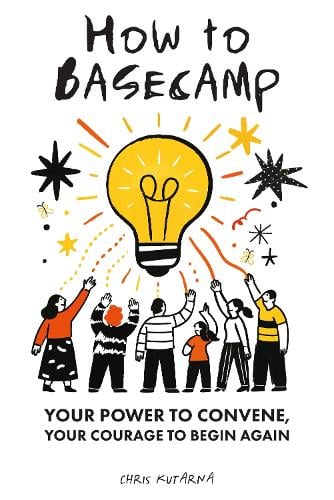
FIELD GUIDE
How to Basecamp
Everything the Basecamps taught us about convening, written down so that anyone can do it: how to gather people around a question none of them can answer alone, in a space where they really listen to each other.
Buy on Amazon About the guide
A compelling invitation to think and lead differently.